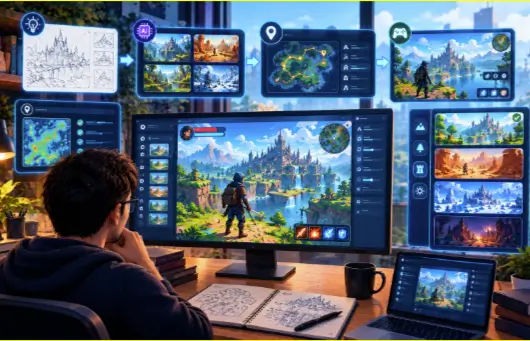

A game world doesn’t need to be large to be good, it needs to be purposeful. Plenty of expansive worlds feel empty and forgettable, while a handful of tightly designed spaces leave a lasting impression because every part of them seems to serve a reason for being there. Building worlds that feel purposeful rather than padded has always taken careful iteration, testing how a space actually plays rather than just how it looks on paper. AI development tools are making that iteration faster, which matters enormously for creators who don’t have the luxury of a large team to manually test every version of a layout.
Why Purposeful Worlds Beat Large Ones
Size Without Purpose Feels Empty
A sprawling world with little reason to explore most of it tends to feel hollow rather than impressive. Players notice quickly when a large space exists mainly to look large, rather than because every section actually offers something worth encountering.
Smaller, Deliberate Spaces Often Leave a Stronger Impression
A tightly designed world where every area serves a clear purpose, whether that’s a gameplay challenge, a narrative beat, or a moment of pacing, tends to stick with players longer than an expansive world padded with filler. Deliberate design usually outperforms raw scale.
Why Building Purposeful Worlds Has Always Been Difficult
Layout Problems Are Hard to Spot on Paper
A world map or level diagram can look reasonable on paper and still feel confusing, empty, or poorly paced once a player is actually moving through it. This gap between how a layout looks from above and how it feels to walk through is one of the most persistent challenges in world design.
Manual Iteration on Layout Takes Real Time
Traditionally, testing whether a layout actually worked meant building it, playtesting it, identifying what felt off, and rebuilding the relevant section, a cycle that consumed significant development time with each pass. Teams without the resources to iterate this way often shipped layouts that were close enough rather than genuinely refined.
How AI Development Tools Improve World Building
Testing Layouts Faster Than Manual Rebuilding Allows
AI-assisted tools let developers adjust a world’s layout and see the result reflected in a playable build quickly, rather than manually reconstructing sections by hand each time something needs changing. This speed makes it realistic to test several layout variations instead of settling for the first version that technically functions.
Identifying Dead Space and Empty Sections
AI can help flag areas of a world that see little meaningful player interaction, surfacing dead space that might otherwise go unnoticed until real players start quietly avoiding or rushing through those sections. Catching this early makes it easier to either cut those areas or give them a clearer purpose.
Generating Variation Without Losing Consistency
Once a world’s core visual and structural identity is established, AI tools can help generate variation within that identity, different room layouts, varied terrain, alternate paths, without requiring each variation to be manually built from scratch.
Building and Testing Worlds With an AI-Assisted Platform
Having faster tools for generating and adjusting layouts only matters if there’s a platform that lets creators actually test how those spaces feel to move through.
A Platform Designed for Fast World Iteration
Astrocade is a good example of a game builder that lets creators put together a world and test it as a playable space quickly, rather than relying only on a top-down map view to judge whether a layout works. This matters especially for world design, since the feel of a space from the player’s perspective is often very different from how it reads on paper.
Seeing Purposeful World Design in a Real Game
Skyline Sentinel: Sand Giants is a good example of a game built around a distinct environment that gives the core experience a clear identity. Games with this kind of focused, purposeful setting tend to feel more cohesive than ones built around a generic or overly expansive space with no clear sense of direction.
What Still Requires Human Design Judgment
Deciding What a World Is Actually Trying to Achieve
AI can help test and refine a layout quickly, but it can’t decide what the space is supposed to make a player feel or accomplish in the first place. That core creative intent still has to come from the designer before any iteration begins.
Recognizing When Variation Starts to Dilute Identity
It’s possible to generate so much variation within a world that its overall identity starts to blur. Part of a designer’s job is recognizing when enough variety has been introduced and further additions would weaken rather than strengthen the world’s sense of place.
Balancing Exploration Against Clear Direction
A world that’s too open can leave players feeling lost, while one that’s too linear can feel restrictive. Striking the right balance between freedom to explore and a clear sense of where to go remains a design decision that depends on the specific kind of experience being built.
Common Mistakes in AI-Assisted World Building
Expanding a World Before Testing Its Core Loop
It’s tempting to keep building outward once AI tools make expansion easy, but a larger world built around an untested core experience often just multiplies whatever problems already existed in a smaller version. Testing a core section thoroughly before expanding tends to produce a stronger result.
Mistaking Visual Variety for Meaningful Variety
Generating visually distinct areas doesn’t automatically mean those areas offer meaningfully different gameplay experiences. A world can look varied while still playing nearly identically from one section to the next, which players tend to notice even if they can’t immediately articulate why.
Ignoring How a Space Feels From the Player’s Perspective
Judging a world primarily from an overhead map or design document can miss problems that are obvious the moment someone actually walks through the space. Regular testing from the player’s actual viewpoint catches issues that a top-down view simply can’t reveal.
A Practical Approach to Building Better Game Worlds
A reasonable process looks like this. Start by defining what a specific space is meant to accomplish, whether that’s a particular challenge, a narrative beat, or a pacing moment, before building it out. Use AI-assisted tools to test the layout as a playable space early, checking how it actually feels to move through rather than relying solely on how it looks from above. Expand gradually, testing each new section on its own before assuming it fits well with what already exists, and watch for dead space or areas players consistently avoid.
Final Thoughts
A better game world isn’t necessarily a bigger one, it’s one where every space feels like it has a reason to exist. AI development tools make it realistic to test and refine layouts far faster than manual iteration ever allowed, which means more creators can build worlds that feel genuinely purposeful rather than settling for something padded out simply because testing every alternative wasn’t practical before.